


Choose quartz when an engineered product and its written care requirements fit your household. Choose quartzite when you want natural stone and are comfortable evaluating the actual slabs, their condition and their maintenance needs. Neither name alone tells you whether a particular countertop is right for your kitchen.
For a San Diego kitchen remodel, the useful comparison happens before you approve fabrication. Identify the surface, review the full slab and compare quotes against the same kitchen drawing. That helps separate a material preference from a change in installation scope.
The featured photo is an AI-generated design concept with unlabelled samples. It does not identify actual quartz or quartzite products and is not a completed Creative Design and Build project.
Quartz vs. quartzite countertops: start with the material identity
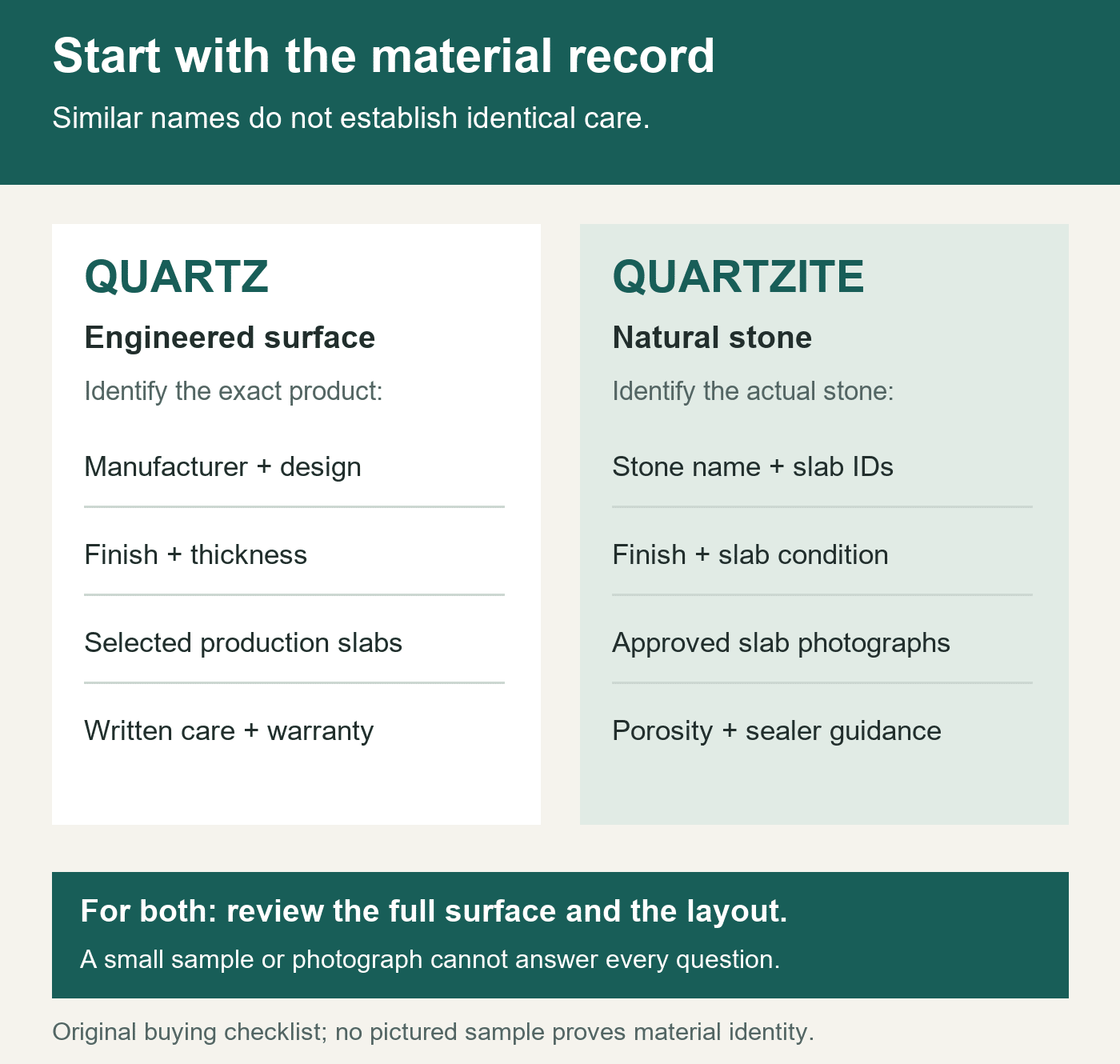
Quartz countertops are engineered surfaces. Manufacturers combine mineral ingredients with binders, pigments and other components. The formula and design depend on the product. Record the manufacturer, collection, design name, finish and thickness; do not rely on a generic percentage of quartz to describe every current surface.
Quartzite is natural stone formed when sandstone undergoes metamorphism. The Natural Stone Institute’s guide to quartzite explains why its identity and porosity matter, including the confusion caused by stones sold under inaccurate labels. A trade name, a pale color or marble-like veining is not enough to establish what a slab is.
Ask the supplier and fabricator to document the natural stone’s identity and explain its observed characteristics. If a surface sold as quartzite behaves unexpectedly around common kitchen acids, ask them to resolve that discrepancy before purchase. Any assessment should use supplier-approved samples or offcuts; do not scratch or apply chemicals to a showroom slab.
What belongs in your material record?
For quartz, retain the exact product information and the current care, installation and warranty documents. For quartzite, retain the stone name, photographs and identifying numbers of the actual selected slabs, the finish and the fabricator’s advice about porosity and sealing. Record thickness for either material.
Both choices need more than a color name. A countertop replacement quote that says only “white stone” leaves too much unresolved. Put the accepted material description in the proposal and clarify whether a substitution needs your approval.
Compare maintenance, heat and everyday wear
The practical question is how you cook, clean and use the counter. Consider daily coffee preparation, oily cooking, acidic ingredients, small appliances and contact at sink edges. Ask for care instructions that match the selected material and finish rather than a broad promise that either surface is maintenance-free.
Sealing and stain resistance
Engineered quartz products commonly require no sealing. Quartzite’s porosity varies, so its sealer selection and renewal schedule should follow advice for the actual stone. Do not assume every quartzite needs the same annual treatment. Sealing can reduce liquid absorption; it does not turn a stone into an indestructible surface.
Get a written cleaning routine, including which products to use and avoid. Clarify what to do if water leaves a darkened area or a spill creates a mark. Distinguish a stain from a change to the surface finish before trying a remedy.
Heat resistance is not permission to skip protection
Use the product’s heat-protection instructions when planning where hot cookware and countertop appliances will sit. For example, Cambria’s quartz product-care guidance calls for hot pads or solid trivets and explains that its surface is not heat-proof. It also addresses cutting boards, edge impacts and cleaning precautions. Those are instructions for that manufacturer’s product, not a warranty for every engineered surface.
For quartzite, ask how the selected slab, finish and any treatments affect care around heat. A natural stone’s geological origin does not establish a safe temperature for every installed countertop assembly.
Scratches, chips and repair expectations
Discuss the exposed edges around the sink, dishwasher and seating area. Ask what damage can be repaired, what a repair might look like and who handles it. A hardness number for a mineral does not answer all those questions about a finished countertop.
If you are still comparing many surface types, our kitchen countertop selection guide provides broader context. Here, keep the decision between your shortlisted quartz product and quartzite slabs.
Approve the full slab and the fabrication drawing
A small sample helps you compare color with your cabinets and flooring. It does not show every vein, patch of color or transition across a complete kitchen. Review the available production slabs for engineered quartz and the actual reserved slabs for quartzite. Photographs are useful records, but lighting and screens can change the appearance.
Look at the proposed surface in relation to the room: the perimeter, island, backsplash and any waterfall end. Decide where you want the main pattern to run, then ask the fabricator what is feasible. Do not assume that a matching sample means a seamless or continuously matched installation.
Separate the kitchen design from the cutting plan
The kitchen drawing establishes where counters, appliances and fixtures belong. The fabrication drawing explains how the selected material becomes those pieces. Ask to see proposed seams, edge profiles, cutouts and any visible pattern changes before authorizing cutting.
Manufacturer instructions can affect that plan. The Vicostone fabrication and installation guideline, for example, covers sample-to-slab differences, countertop layout, seam positions and cabinet/support inspection. Your fabricator should apply the requirements for your chosen product. A drawing suitable for one surface should not automatically be treated as suitable for another.
Have the team identify how the counter will be supported, including at overhangs and openings. Provide the selected sink and cooktop information so the openings can be coordinated with those products. These are questions for the design and fabrication team, not dimensions to guess from a photograph.
Use a short approval record
- Material: exact product or slab IDs, finish and thickness.
- Appearance: accepted slab photographs and pattern direction.
- Fabrication: reviewed seam, edge and cutout proposal, with any limitations explained.
- Installation: support requirements and responsibilities for cabinet preparation.
- Care: written cleaning, heat-protection and sealer advice where applicable.
Ask the fabricator to explain any uncertainty while changes are still possible. Keep the accepted revision with the proposal so the material selection and installation instructions refer to the same project.
Compare quartz and quartzite quotes against the same scope
A lower total may reflect a different slab, edge treatment, backsplash or installation allowance. Before deciding which material is more expensive for your kitchen, give each bidder the same room drawing and list of required work. Identify material-specific changes separately.
Ask whether the material charge is based on finished countertop area, whole slabs or another stated basis. Confirm how slab use, offcuts and any requests about pattern placement affect the proposal. A price per square foot without its inclusions is not a complete installed quote.
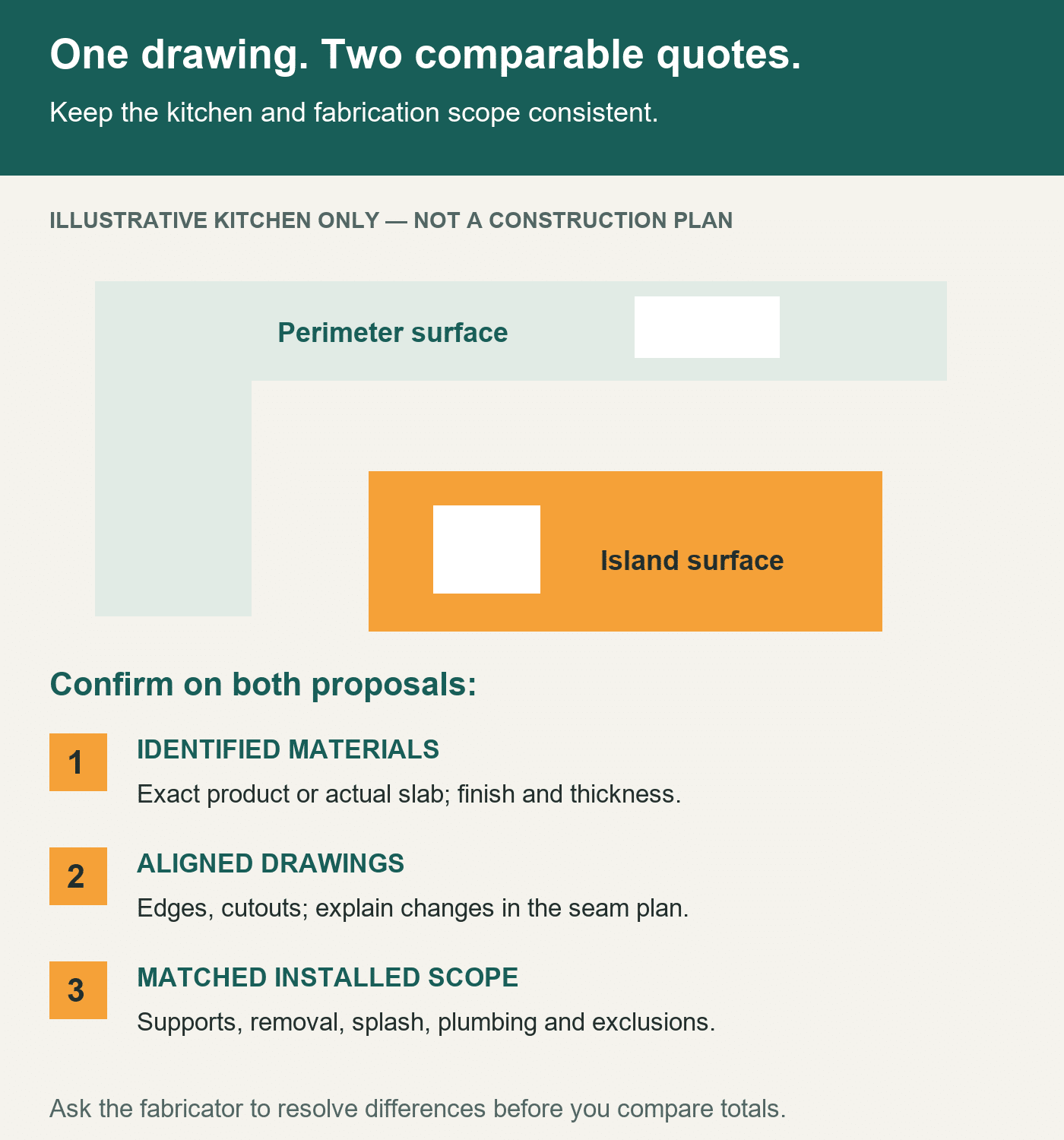
One kitchen, two proposals: resolve the differences first
Imagine replacing the perimeter and island countertops while keeping the cabinets, sink location and cooking appliances. One quartz proposal includes removal of the old tops, sink cutout, edge finishing and installation, but lists plumbing reconnection separately. A quartzite proposal includes those items and reconnection, while allowing for a different seam arrangement.
These are hypothetical scopes, not Creative Design and Build prices or project results. The totals would not yet tell you the cost difference between the materials. First clarify reconnection in both quotes, review the seam proposals and confirm whether each includes the same backsplash work, disposal and cabinet preparation.
The useful outcome is a pair of clearly described alternatives. If the quartzite layout needs a different slab arrangement or the quartz option needs a different support detail, retain that difference and its reason. Comparable quotes do not require pretending the materials are interchangeable.
For the wider project budget, use our San Diego kitchen remodel cost guide. Keep the countertop choice separate from unrelated changes to cabinets, flooring or the room layout.
Which countertop fits your household?
Quartz is a sensible candidate when you find an engineered design you like and its care requirements suit your routine. Quartzite is worth considering when the individual stone’s appearance matters to you and you accept the care and fabrication requirements of the actual slabs. Review the selected option, rather than choosing a winner for every kitchen.
Bring sample information, slab photographs and your current kitchen layout to a consultation. Creative Design and Build’s kitchen remodeling service can help you discuss how the countertop choice fits the overall project. Contact our team to review the design and construction scope for your San Diego home.


