


The image above is an AI-generated deck design concept, not a completed Creative Design and Build project.
Which deck material fits the way you will use it?
Choose composite decking if reducing routine refinishing is a priority and the specific board meets your appearance, comfort and budget requirements. Choose wood if you value its individual grain and finishing options and accept the care plan for that species. Either choice still needs a suitable supporting structure and correct installation.
A useful composite decking vs. wood comparison starts with your household, then moves to exact products. A brand name or a small showroom sample cannot tell you how the finished deck will look beside your home, what care you will actually do or whether existing framing can be reused.
This guide provides a selection worksheet for San Diego homeowners choosing surface boards. Our deck and patio renovation ideas cover broader outdoor design. Here, the goal is to narrow the materials to a defensible shortlist before you order.
Differences between wood and composite decking
Conventional wood plastic composite decking is made from a blend of wood fibers and plastic. Many products add a protective outer cap. The composition, cap coverage, profile and approved uses vary. “Composite wood” is a broad marketing description; ask for the exact manufacturer and collection. PVC decking is a separate product category and should be identified separately in a comparison.
Wood decking materials also need a specific name. Pressure-treated wood, cedar, redwood and premium hardwood are different purchasing choices. Record the wood species, grade, dimensions and proposed finish. Comparing the least expensive lumber against a premium composite material does not reveal the price difference between every wood and composite option.
| Selection question | Wood deck | Composite deck |
|---|---|---|
| What are you choosing visually? | Species, grain variation, grade and finish. | Collection, color, texture, cap and board profile. |
| What care should you plan for? | Cleaning plus the finish manufacturer's preparation and renewal plan, if finished. | The selected product's cleaning and spill-response instructions. |
| How will you address wear? | Confirm suitable refinishing and board-replacement options. | Confirm approved surface treatments and how an individual board is replaced. |
| What supports the boards? | A separately assessed, properly designed structure. | A separately assessed structure compatible with that board's installation requirements. |
The pros and cons become useful when attached to a particular product and owner. Composite decking offers a way to avoid a recurring wood-stain project; wood decking offers the look of natural wood and a finish choice you can evaluate directly. Neither statement settles the rest of the selection.
Write your requirements before choosing wood or composite decking
Give each requirement one of three labels: essential, preferred or flexible. An essential requirement should have an answer before purchase. A high score for color cannot compensate for an unanswered structural or installation question.
- Use: Will this be a dining deck, a frequently used route to the yard or a quiet seating area? Note chairs that move often, pets and nearby cooking.
- Exposure: Record when the surface gets direct sun, where shade remains, nearby irrigation and whether debris collects under trees.
- Appearance: Decide whether you want a fairly consistent wood look or individual grain and color variation. Include the fascia, stair edges and visible fasteners.
- Care: State who will clean the deck and whether anyone is willing to prepare and renew a wood finish.
- Budget: Set a complete installation allowance and a separate annual care allowance. Include any paid help you expect to use.
For a San Diego property, describe the conditions at the actual deck rather than relying on the city name. A shaded side yard and an exposed afternoon seating area present different selection questions. Photographs taken at different times can help a contractor understand the exposure you are trying to accommodate.
If you plan to build a deck with a later shade structure, include that intention now. Ask how it affects the structure and approvals. Treat shade as part of the design and budget rather than assuming a different board alone will solve comfort concerns.
Check composite deck boards and real wood samples at home
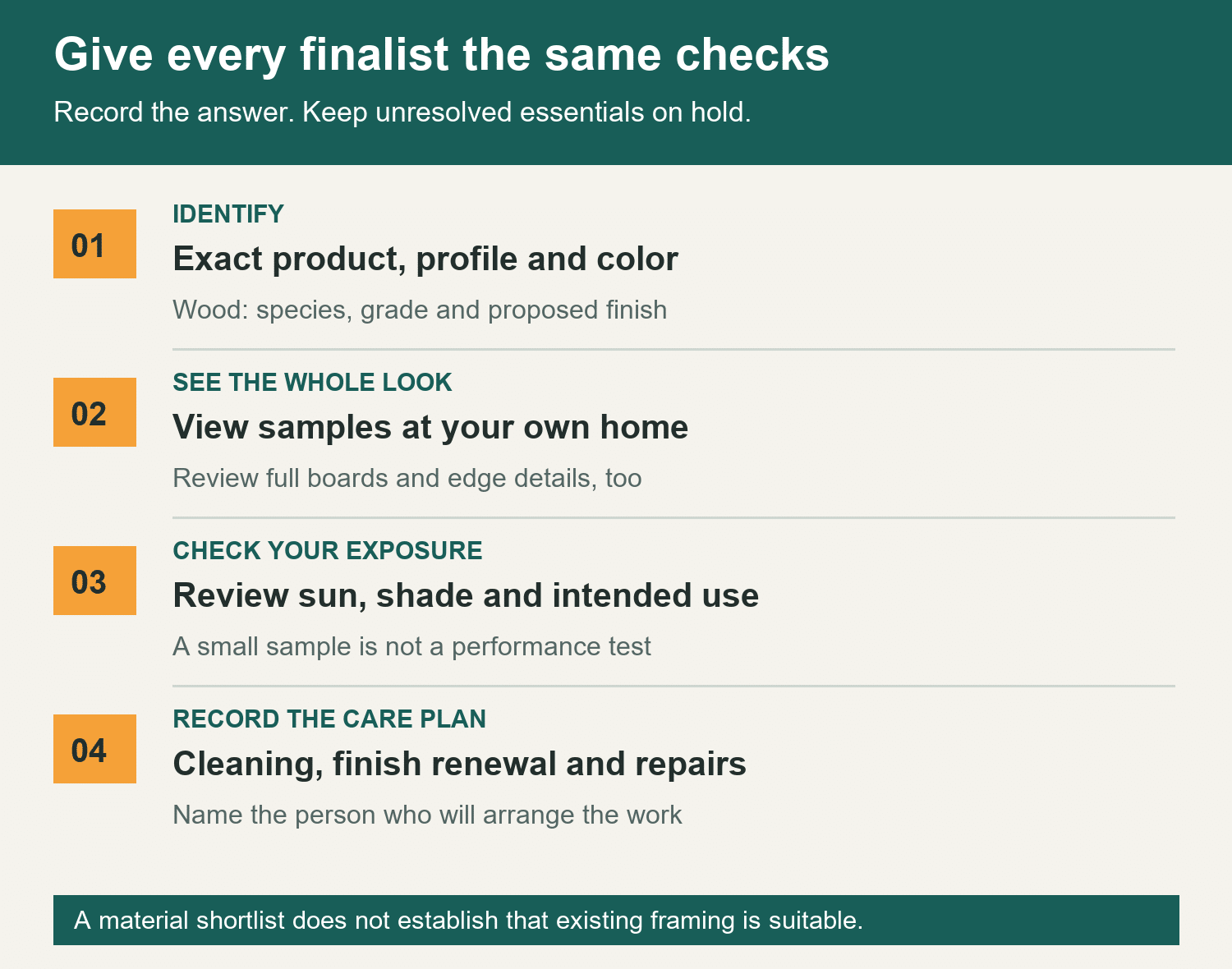
Bring home samples of the exact finalists. Label the manufacturer, collection, color and profile; for wood, record the type of wood and finish. Keep those identifiers with the proposal so a substitution cannot quietly change what you selected.
Compare the finished appearance at more than one scale
Look at the samples beside your siding and exterior doors in sun and shade. Ask to see several full boards or an installed display of the same collection. A hand-sized sample cannot show how repeated grain patterns, streaking or natural variation will read across the whole deck.
For cedar decking or another finished wood option, ask for a sample with the proposed stain system. The look of an unfinished sample is not the promised appearance of the finished wood deck. If you prefer weathering, ask what appearance variation and cleaning are expected rather than assuming a uniformly aged color.
Does composite decking get too hot?
Composite decking gets hot in direct sun, as can wood and other outdoor surfaces. Color, product and exposure matter. Trex's heat-performance guidance says even its heat-mitigating boards can become hot on sunny, hot days. A cooler-product claim is a comparison under stated conditions, not a promise of a cool surface.
Compare finalists in similar outdoor conditions and review the manufacturer's test information. A sample check can reveal a concern, but it is not a laboratory test or a guarantee for peak summer weather. Do not test a hot board with bare skin. Discuss shade and footwear needs if barefoot comfort is essential.
Ask about wet use, moving furniture and replacement
Feel the dry texture and request product-specific information about wet traction for the intended location. A rough-looking grain pattern alone does not establish slip performance. Ask which furniture feet, mats and cleaning tools are compatible. Do not deliberately scratch or stain a sample and treat that informal test as a warranty assessment.
Ask the installer to explain how a damaged board would be removed, especially with hidden fasteners or a picture-frame border. Record whether spare boards will be supplied. Keeping spares may help with future repairs, but a stored board may not match the appearance of weathered boards exactly.
Care, stain renewal and durability: what are you willing to maintain?
Lower maintenance does not mean maintenance-free. Composite and wood decking both need a realistic owner-care plan. For a finished wood deck, identify the cleaner, preparation, finish and conditions that trigger renewal. Avoid assigning the same staining interval to every species, coating and exposure.
The Western Red Cedar Lumber Association's cedar deck care guidance recommends annual cleaning, removing debris and allowing the deck to dry. It warns that power washing can seriously damage cedar. Those instructions illustrate why a cleaning method suitable for one material should not be transferred to another.
For composite deck materials, obtain the current care guide for the actual collection. Cleaning with soap and water is allowed for some products; cleaner choice, tools and spill deadlines can differ. Ask before using a pressure washer, sanding a mark or applying a coating. Keep the approved instructions with the purchase records.
Which decking lasts longer?
A universal lifespan for wood vs. composite would hide too many variables. Compare the selected boards' requirements, installation, exposure and intended care. Also separate surface durability from the service life of the framing beneath it. A long board warranty does not establish that the whole deck will remain suitable for the same period.
Review the warranty's covered conditions, exclusions, claim process, transfer terms and treatment of removal or installation labor. Ask who handles a claim and what documentation to keep. A warranty length is a contractual term, not a prediction of when your wood deck or composite deck will need work.
Likewise, compare environmental claims product by product. Ask for evidence behind recycled-content or sourcing claims, expected maintenance products and an actual local disposal or take-back route. Recycled content alone does not establish that an old composite board can go into your curbside recycling bin.
Can you install composite decking on an existing wood deck?
Surface-board selection and structural suitability are separate decisions. Do not approve resurfacing because the old deck still feels firm. Have the supporting frame, connections, footings and overall layout assessed before deciding what can remain.
TimberTech's installation and product FAQs require a suitable, code-compliant substructure for replacement boards and say not to install new boards over old decking. Their guidance also distinguishes decking from primary load-bearing structural members. Confirm the current instructions for whichever product you select.
Ask the contractor to document joist and stair-support compatibility, board thickness, fasteners, required gaps and any blocking or other alterations. Board direction can affect the installation requirements. Use the exact product's guide rather than carrying a spacing rule from a different wood or composite board.
For a replacement wood deck, ask the same structural questions. Changing species or board dimensions does not remove the need for an assessment. A proposal should explain what was inspected, what remains unknown until the boards are removed and how additional work will be approved.
Our San Diego deck-building service covers the broader project assessment. Bring your material shortlist to that conversation so the structure and board choice can be reviewed together.
Composite decking vs. wood cost comparison: use your own care assumptions
Compare complete deck costs before comparing a board's cost per square foot. Identify demolition, disposal, structural work, surface boards, fasteners, fascia, stairs, railings, design and approvals where required. Ask whether the initial wood finish is included. A board-only price cannot establish what the new deck will cost.
Composite decking may cost more up front than a basic wood option, while premium wood can change that relationship. Use current, project-specific proposals. Calculate the cost of composite and the selected wood deck over the same ownership period without assuming that reduced refinishing automatically recovers a higher upfront cost.
A 10-year example that does not assume composite wins
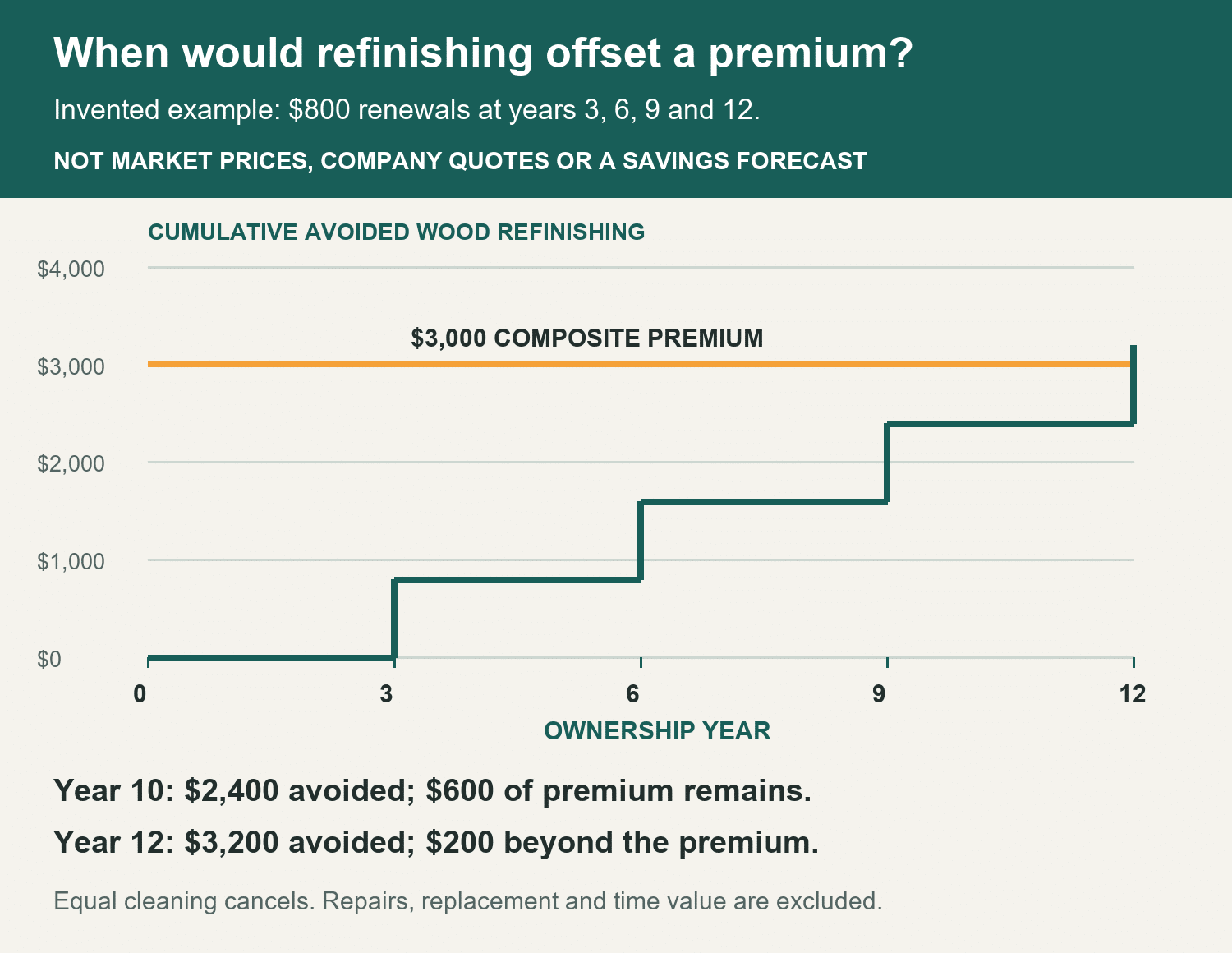
These are invented teaching amounts, not San Diego market prices or Creative Design and Build quotes. Assume two complete installations with the same footprint and agreed structural scope: $10,000 for finished wood and $13,000 for composite. Both receive $150 of routine cleaning each year. The wood option also receives an $800 finish-renewal service at the end of years 3, 6 and 9.
| Hypothetical 10-year spending | Wood deck | Composite deck |
|---|---|---|
| Complete initial installation | $10,000 | $13,000 |
| 10 annual cleaning services × $150 | $1,500 | $1,500 |
| 3 finish renewals × $800 | $2,400 | $0 assumed |
| Total through year 10 | $13,900 | $14,500 |
In this example, the composite deck remains $600 more expensive through year 10. The $3,000 initial premium exceeds the $2,400 of avoided refinishing. If the same assumptions continue, a fourth $800 renewal at the end of year 12 brings wood to $15,000 including cleaning, versus $14,800 for composite.
This is a simple cash-spending comparison with constant dollars. It excludes financing, inflation, resale value, owner time, repairs and replacement of boards or framing. It assumes both decks remain usable throughout; it does not predict either material's lifespan. Cleaning is equal only to isolate the finishing decision. Replace every assumption with your actual plan.
Change one assumption before you decide
At $500 per renewal instead of $800, four renewals would total $2,000, leaving $1,000 of the premium unrecovered through year 12. At $1,000 per renewal, three renewals would equal the $3,000 premium by year 9. Neither result establishes an appropriate maintenance interval; those are sensitivity checks using the same hypothetical three-year schedule.
If you maintain your own wood deck, include supplies and list your time separately. If you will hire help, get a care estimate that includes preparation and moving furniture. The right decking choice may depend as much on willingness to arrange that work as on the calculated total.
Make a shortlist you can explain to your installer
For each of two or three finalists, write a short decision record:
- Selected product: Exact composite collection and profile, or wood species, grade and finish.
- Essential requirements: Answered, unresolved or unsuitable, with evidence from samples and product documents.
- Installation: Structural assessment completed or still needed, with required alterations identified.
- Care and repairs: Named owner, written cleaning plan, finish-renewal assumptions and board-replacement method.
- Cost: Complete installation price and ownership calculation using the same time period.
Choose composite decking when the exact product meets your essential requirements and the price is justified by the appearance and care commitment you want. Choose a wood deck when its grain, finish and purchasing terms fit your priorities and you accept its maintenance plan. Keep a product on hold when an essential answer is missing.
Ready to compare materials for your property? Contact Creative Design and Build with approximate deck dimensions, photographs, your exposure notes and the products you are considering. That gives the first assessment a useful starting point.


